Open sourceAI workflow design and CLI implementation
mini-cursor
A terminal AI coding assistant that experiments with agent workflows, command execution, and project scaffolding.
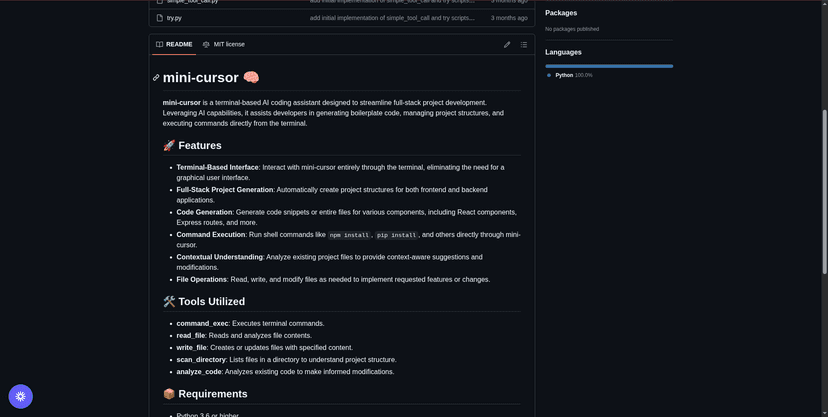
Problem
AI coding helpers are useful when they can reason over a task, produce files, and interact with the local environment. The goal was to explore that loop in a compact terminal-first tool.
Architecture
- A CLI interface accepts developer prompts and project context.
- LangGraph coordinates multi-step agent flows and tool execution.
- LangChain integrations handle model calls and structured workflow steps.
- Command execution is exposed through a controlled terminal layer.
Key decisions
- Used a terminal interface because coding work already happens close to the shell.
- Separated workflow orchestration from model calls so agent steps remain easier to debug.
- Kept generated boilerplate explicit instead of hiding file changes behind automation.
Tradeoffs
- Direct command execution makes the tool powerful, but it needs strong guardrails before broader use.
- Agent graphs add structure, but they also add complexity compared with a single prompt-response loop.
What I learned
- Agent tools become more useful when every action is inspectable.
- Workflow orchestration is only valuable when it reduces uncertainty for the developer.
Stack
PythonLangGraphLangChainAITerminalWorkflow OrchestrationCode GenerationCLI